
Gachapon Trick
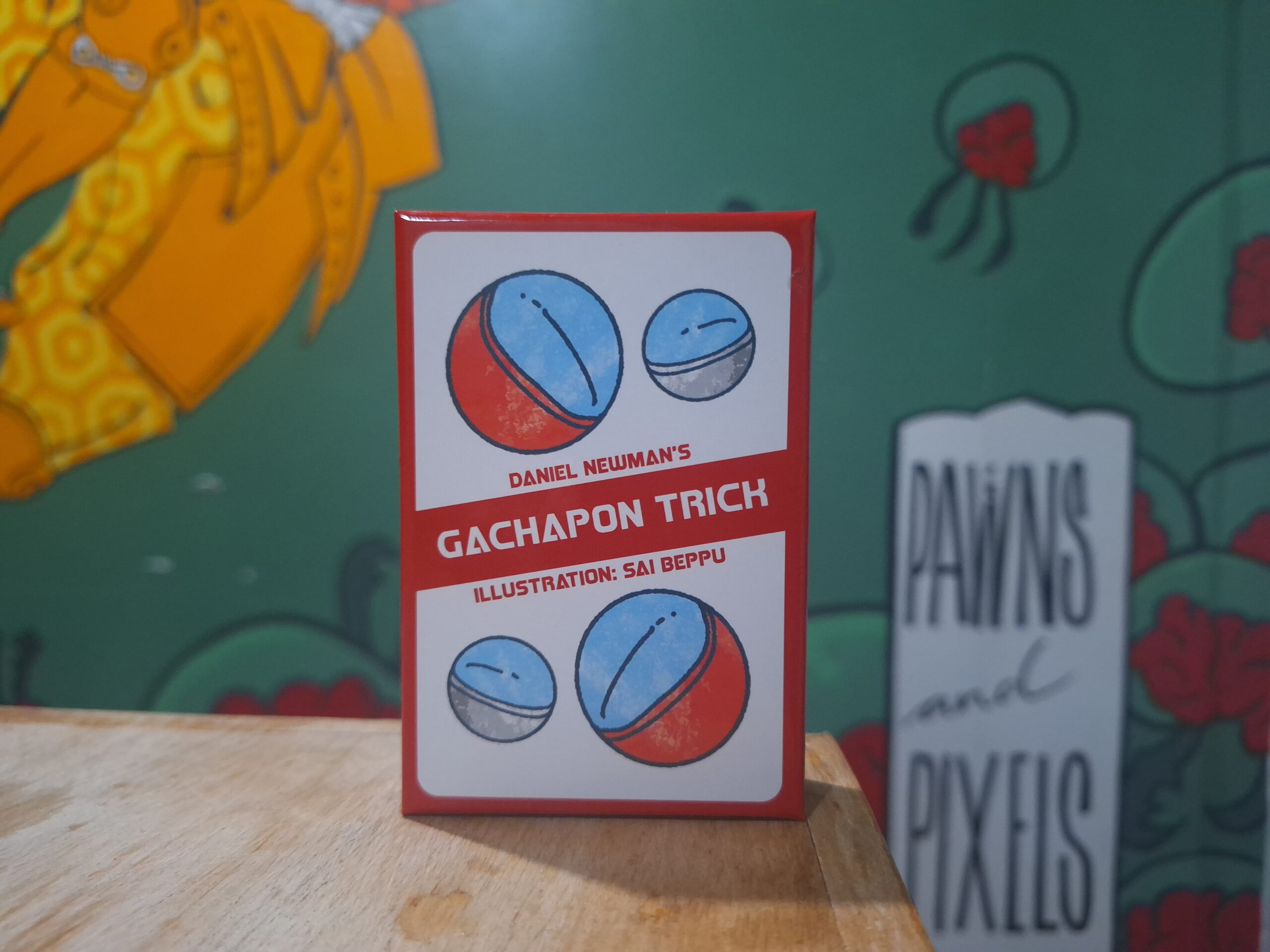
A trick-taking game published by New Mill Industries where players play tricks over 10-12 hands in order to try and gain the most points by collecting sets of cards.
How the game works?
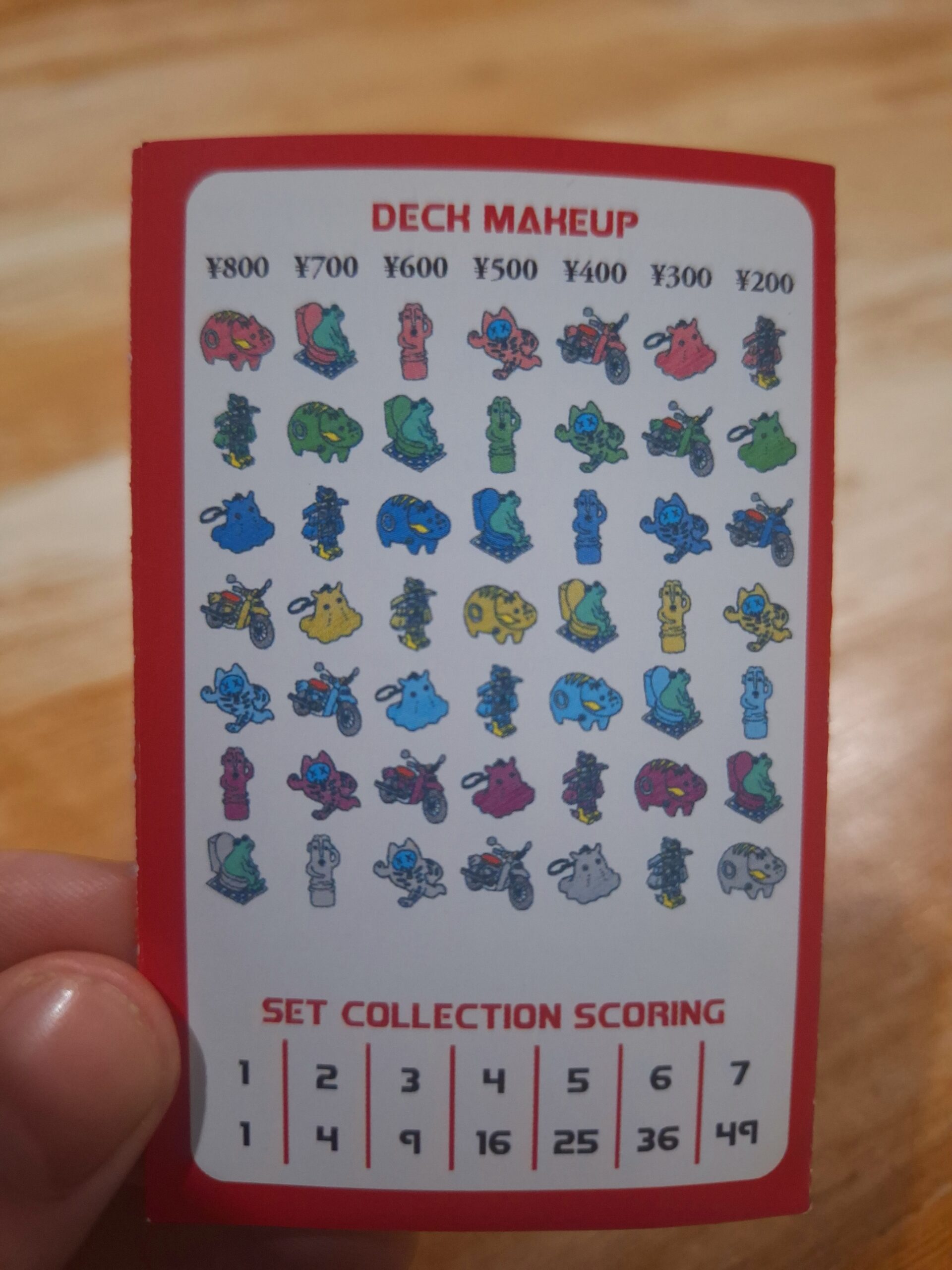
The objective of Gachapon Trick is to win points by collecting sets of cards and conserving as much money as possible. Players start the game with ¥5000 (¥8000 for 2-players) and 10 cards (12 for 3-players). Tricks are played following suit with the highest value card of the most represented suit winning the trick (with the most latter card winning ties). The winner then chooses to purchase at least one, but may purchase up to all cards that were played in the trick including a mystery gachapon from the draw deck for ¥500. Once all tricks have been played, points are calculated depending how many sets of gachapon toys you collected and an additional point for every ¥200 you didn’t spend. After 3 rounds whoever got the most points wins.
Gameplay and thoughts
Gachapon Trick incorporates set collection, a mechanic which most trick-takers don’t use, in order to determine victory points. This was my first time playing a game that does so, and I have to say, it was tons of fun. I felt like a Pokémon hunter, trying to collect as many gachapons as I could and, when I was feeling frisky enough, taking a swing at the mystery deck to add another toy to my ever-growing collection. The satisfaction of drawing something I needed to complete a large set is one of the highlights of the game. Equally entertaining for the rest of the group, however, is when someone draws a completely useless ¥200 toilet frog that they didn’t need.
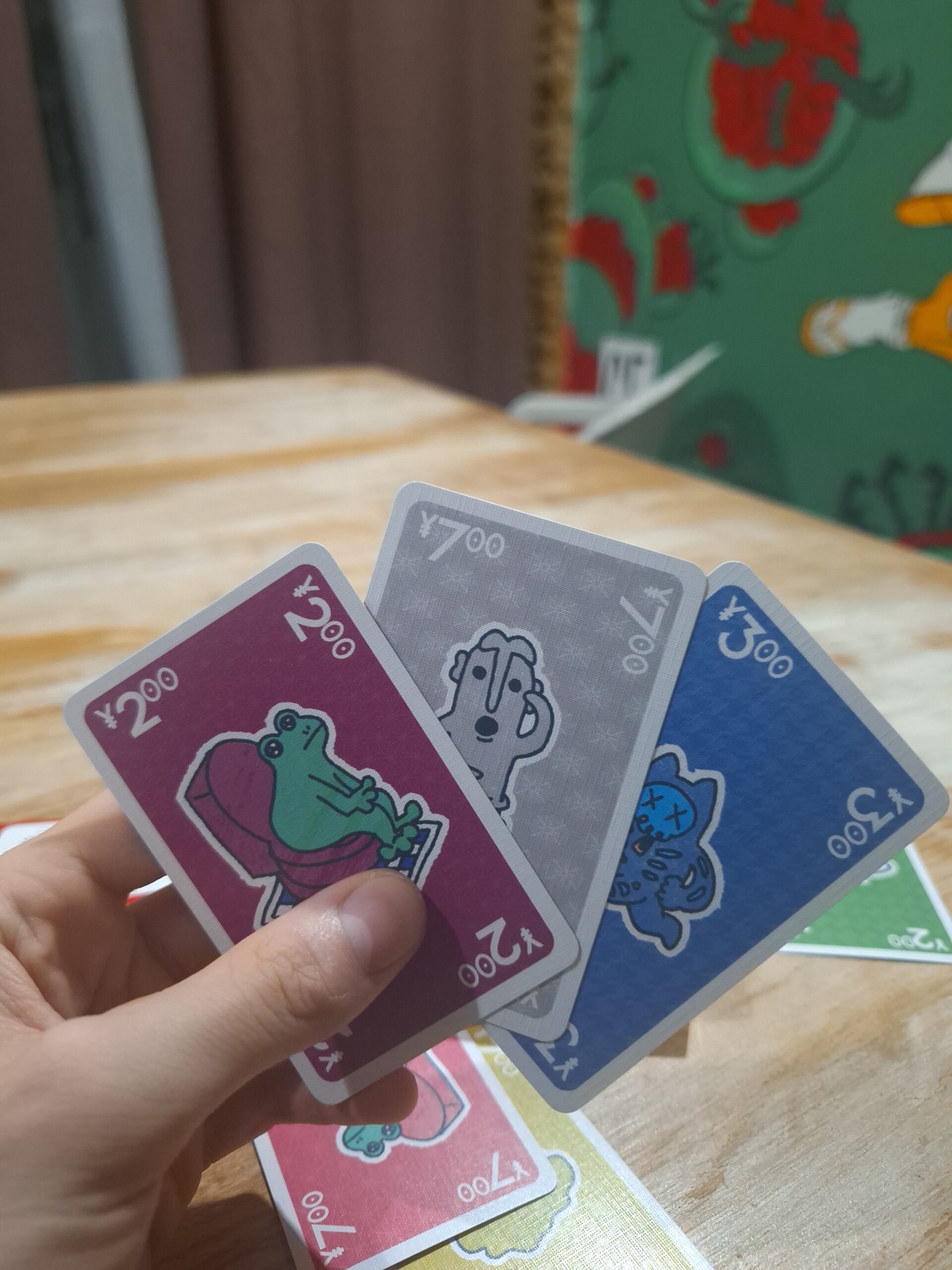
The game plays in an interesting way such that playing strong cards allows you to win tricks and buy toys. However players also holding strong cards of the same suit too will generally play those to force you into spending more money than you want to. Winning these rounds early on allows you to build up a small collection so you can aim for specific toys, but players who have options for cards to play will choose to present you toys that you don’t own, as having too many sets of toys scores very low points.
I think one of the best parts of this game — which isn’t talked about enough — is the tie-breaker system. I’ll give you an example of how it works. Say that Player A plays a ¥600 green card. Player B doesn’t have any green cards, so he plays a ¥300 red card instead. In most trick-taking games, players are required to follow the leading suit (in this case, green). However, the rules here state that “the following players must follow any of the suits already played, if possible.” That changes everything. If Player C has both a ¥200 green card and a ¥700 red card, they can choose to follow red instead of green — and win the trick with the ¥700 red card.
Another interesting strategy which pays off more often than not, is simply not spending any money at all. After all, resisting the lure of the gachapon has its advantages since you can easily gain 25 points by losing all the tricks on purpose. Which leads me to my next point… player count.
Bear in mind this review is only for a 3-4 player game as that’s all I have played so far, but with this experience I actually strongly recommend playing 3 players over 4. My reason for this is that with 3 players not only do you start with extra cards, you also have a higher chance of winning more tricks and collecting more gachapon which makes the game feel more competitive. As from our experience in a 4 player game, you can end up getting “stuck” and not winning any hands as other players will lack cards of your color or simply play higher cards. Let me know what you think, but I felt 3 players was the ideal player count as it felt more competitive to us since everyone had a much more equal chance of winning hands.
Gachapon Trick is honestly some of the most fun I’ve had playing cards. The thrill of people playing cards in the set you need combined with the ¥500 mystery card creates so much excitement and laughter that I’m always dying to bring this out to a game night to see if I can get more than 4 or 5 sets of one toy in my collection to score big.
Pros
- The Gachapon toilet frog card
- Set collection mechanic blends seamlessly with the core trick-taking aspect
- Tie-breaking system leads to more opportunities to play different cards
- Color coding and squared point system makes gameplay smooth and easy to remember
Cons
- Not spending any money tends to give more points than people playing to win
- A tendency to get stuck and locked out of gameplay especially with 4 players
- A lot of luck is involved, especially drawing from the mystery deck
Would I recommend this?
For a warmup or cooldown game, this is definitely something I could recommend to bring out as it plays quick, is easy to learn, has replayability and is great fun.